
 EN
EN  ES
ES  PT
PT  RU
RU  FR
FR A client’s pallet collapsed in a 50°C container because their previous supplier ignored shear strength. We fixed their production line by focusing on bond stability, not just stickiness.
A reliable double-sided tape manufacturer must provide precise chemical consistency, coating tolerances within 2 micron, and laboratory validation for specific substrates. Buyers should prioritize technical performance data over unit costs to prevent costly bond failures and production downtime during long-distance shipping or extreme temperatures.
Let’s look at the technical details that keep your products together and your supply chain moving.
The Holding Power Trap: Why Initial Tack is a False Friend
In our laboratory, we see many tapes that feel sticky but slide right off under a load. We test for hours, not seconds, to find the truth about adhesion.
High initial tack often masks poor long-term holding power. Industrial buyers must request 72-hour static shear test results to verify the adhesive does not creep or fail under constant stress, especially when exposed to heat or varying humidity levels during transit.
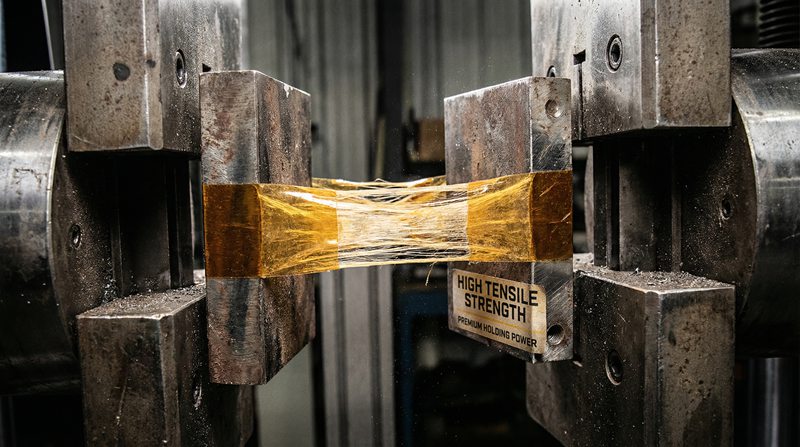
When we talk to procurement managers, they often test tape by pressing a finger against the adhesive. This measures “Quick Stick” or “Initial Tack.” In the factory, we know this is a dangerous metric. High tack is easy to achieve by adding soft resins or plasticizers to the glue. These chemicals make the tape feel aggressive. However, these same chemicals often cause the adhesive to turn into a liquid-like state when put under pressure or heat.
Our engineers use the Static Shear Test (ASTM D3654) to measure how long a tape can hold a specific weight. A tape might have a high peel strength of 20N/25mm but fail a shear test in less than ten minutes. This failure happens at the molecular level. If the polymer chains in the adhesive are not cross-linked correctly, they will slide past each other. This causes “creep.” In a shipping container, creep means your labels fall off or your components shift.
We always suggest looking at the balance of three properties: Tack, Peel, and Shear. Most cheap suppliers sacrifice shear to make the tape feel “stickier” during a quick demo. We maintain a strict balance to prevent field failures.
| Adhesive Property | What it Measures | Field Impact | Risk of Failure |
|---|---|---|---|
| Initial Tack | Immediate bond on contact | Ease of application | High if used alone |
| Peel Adhesion | Force to remove the tape | Bond strength | Medium |
| Static Shear | Resistance to sliding | Long-term stability | Very High (The “Hidden” Failure) |
Substrate Selection: Matching Chemistry to the Bonding Surface
Our production team often helps clients who use the wrong carrier for their specific plastic. We match the tape chemistry to the surface energy to prevent debonding in the field.
Effective bonding requires matching the tape carrier and adhesive chemistry to the surface energy of the substrate. Using a general-purpose tape on low-surface-energy plastics like polypropylene leads to bond failure, requiring specialized adhesives for a permanent, high-performance industrial seal.

Surface energy is a physical property of the material you are trying to bond. We measure this in dynes per centimeter (dyn/cm). High-surface-energy (HSE) materials like stainless steel or glass are easy to bond because the adhesive “wets out” or spreads across the surface. Low-surface-energy (LSE) materials like polyethylene (PE) or polypropylene (PP) act like a non-stick pan. The adhesive beads up and stays on the surface rather than soaking into the microscopic pores.
In our factory, we produce different carriers to solve these problems. A tissue carrier is flexible and conforms to irregular shapes. A PET carrier adds dimensional stability and high temperature resistance. If you use a standard acrylic adhesive on an LSE plastic, the bond will look fine for a day. Then, the tape will simply pop off. This is because the chemical attraction was never established.
We provide technical data sheets that map our tape types to specific surface energy levels. This helps buyers avoid the mistake of buying a “one size fits all” product. Choosing the right carrier and adhesive chemistry is the only way to lock in a permanent bond.
| Substrate Type | Surface Energy Level | Examples | Recommended Adhesive Base |
|---|---|---|---|
| HSE Plastics | High (>40 dyn/cm) | ABS, Polycarbonate, Nylon | Modified Acrylic |
| LSE Plastics | Low (<36 dyn/cm) | PE, PP, TPO, Teflon | High-Bond Synthetic Rubber |
| Metals | Very High | Stainless Steel, Aluminum | Pure Acrylic (High Temp) |
| Foams | Variable | EVA, EPDM, PU Foam | Solvent-Based Acrylic |
The 2 micron Difference: Manufacturing Precision and Consistency
We calibrate our coating heads daily to keep our adhesive layers even. Slight variations in thickness can cause your automated assembly lines to jam or skip during high-speed production.
Manufacturing precision involves maintaining adhesive coating tolerances within 2 micron across the entire roll width. This consistency prevents machine downtime, secures uniform stress distribution across the bond line, and eliminates common defects like telescoping or edge-ooze during storage and application.
Precision in manufacturing is what separates a world-class factory from a small workshop. When we coat double-sided tape, we must apply the glue at an exact weight. If one side of the roll is 50 microns thick and the other side is 55 microns, the roll will become uneven. This is called “telescoping.” When your workers try to use that roll on an automatic dispenser, it will wobble or snap.
Our engineers focus on the “wet-out” time and drying tunnel temperatures. If the tape dries too fast, it creates bubbles. If it dries too slow, the solvent stays in the glue and makes it mushy. We use sensors to monitor the thickness in real-time. This level of control means every meter of tape in a 1000-meter roll performs exactly like the first meter.
Uneven coating also creates “dry spots.” These are areas with less adhesive that lead to weak points in your final product. If you are bonding heavy trim to a car door or a TV screen, a single dry spot can lead to a crack or a total bond failure. We invest in high-end slot-die coating heads to keep these tolerances tight. This protects your brand from defects that happen weeks after the product leaves your warehouse.
| Manufacturing Metric | Standard Grade Tolerance | Wingtai Precision Grade | Impact on Your Factory |
|---|---|---|---|
| Coating Thickness | 5-8 | 2 | Prevents assembly jams |
| Slitting Width | 1.0 mm | 0.2 mm | Perfect fit in housings |
| Adhesive Weight | High Variation | Controlled | Uniform bond strength |
Conclusion
Price is what you pay; stability is what you get. Don’t audit a manufacturer’s price list—audit their laboratory’s 72-hour static shear test reports to secure your supply chain.