
 EN
EN  ES
ES  PT
PT  RU
RU  FR
FR 
I know the difficult position you are in. You want to choose eco-friendly packaging, but the high cost of green alternatives is a huge problem. This choice between planet and profit is a daily stress.
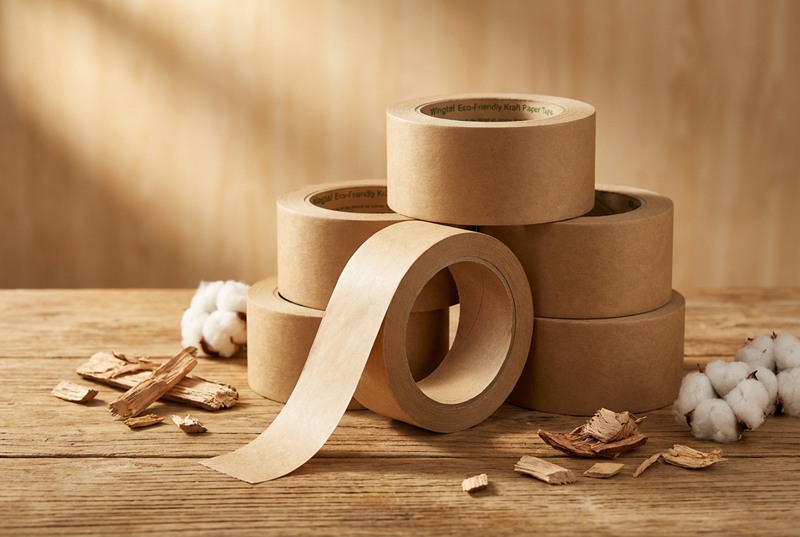
Kraft paper tape biologically degrades within months, while BOPP plastic film lasts for centuries and creates microplastics. However, Kraft tape costs 3 to 4 times more than BOPP, so BOPP remains the dominant choice in most price-sensitive markets despite its negative environmental impact.
This cost gap is the central issue. As a manufacturer at Wingtai, I help clients navigate this decision every day. Let’s break down the real science and business facts, so you can choose the right tape for your specific market—whether it is driven by price or by regulations.
Is Kraft paper tape 100% biodegradable compared to plastic BOPP?
Many of my clients ask if the high price of Kraft tape is truly worth it. You are right to question if you are paying for real science or just clever marketing.
Yes, unreinforced Kraft paper tape is 100% biodegradable because its wood pulp backing and starch-based adhesive are organic materials. In contrast, BOPP is a synthetic plastic that never truly disappears; it just fragments into smaller, harmful microplastics that pollute the environment forever.

When we talk about biodegradability, we mean whether nature can eat the material. At Wingtai, we see this in our material tests. Kraft paper is made from trees. Its main component is cellulose. If you bury a piece of our unreinforced Kraft tape in soil, microorganisms like bacteria and fungi see it as food. They consume the paper and the natural starch adhesive. Within a few months, it completely returns to the earth as harmless biomass. It is a true chemical breakdown.
BOPP (Biaxially Oriented Polypropylene 1) is the opposite. It is made from petroleum. Nature does not have enzymes to digest it. When you throw it away, it just sits there for hundreds of years. Sunlight might make it brittle, causing it to crack into tiny pieces, but each piece is still plastic. This creates microplastics 2 that get into our water and food systems. The acrylic adhesive on BOPP tape is also a synthetic polymer, which creates a non-porous barrier that stops any potential degradation.
The Cost Reality Check
So, if Kraft is so much better for the planet, why does BOPP dominate the market? The answer is simple: price. The cost of Kraft paper as a raw material is much higher than polypropylene. The production process is also slower. The combination of these factors makes Kraft tape 3 to 4 times more expensive than BOPP tape. For many of my clients, especially those in high-volume industries or developing countries, this price difference is just too large to ignore. So, while Kraft wins on ecology, BOPP wins on economy.
Comparison of Core Materials
This table shows why the performance and price are so different.
| Feature | Kraft Paper Tape (Unreinforced) | BOPP Packing Tape |
|---|---|---|
| Raw Material Source | Renewable Wood Pulp | Non-renewable Petroleum |
| Adhesive Type | Natural Starch or Rubber | Synthetic Acrylic or Hot Melt |
| End-of-Life Process | Biological Decomposition (Rotting) | Physical Fragmentation (Breaking) |
| Time to Disappear | 2-6 Months | 400+ Years |
| Relative Cost | High ($$$$) | Low ($) |
Do I need to separate Kraft tape from cartons for recycling?
I know you hate seeing your customers waste time and money. Peeling tape off hundreds of boxes is a hidden labor cost that eats into profits.
You do not need to separate unreinforced Kraft tape from cartons because it is “repulpable,” meaning it recycles seamlessly with the cardboard. In contrast, BOPP tape is a major contaminant in paper mills that must be removed, otherwise it clogs machinery and creates plastic waste.

Recycling compatibility is a huge issue for my clients in places like Japan and Korea, where regulations are very strict. When a cardboard box is recycled, it goes into a giant vat of water called a pulper. This machine acts like a huge blender, turning the cardboard back into a watery pulp to make new paper products.
If the box is sealed with Kraft tape, the tape acts just like the box. Its paper fibers break down and become part of the new paper pulp. This is perfect for a circular economy 3. It requires no extra labor from your customer.
The “Ragger Tail” Problem
If the box is sealed with BOPP tape, a big problem occurs. The plastic tape does not break down in the water. Instead, it gets tangled with other plastics, labels, and metal staples. This mess forms a long, dirty, rope-like object. In the industry, we call this a “ragger tail.” The entire paper mill has to shut down so workers can pull this giant rope of waste out of the machinery. Then, they have to pay to send it to a landfill. This is why recycling plants hate plastic tape. If a batch of cardboard has too much plastic contamination, they might reject the whole load. This shows that the initial low cost of BOPP tape creates higher costs for someone else down the line.
Operational Efficiency vs. Material Cost
This creates a clear choice for your business:
| Process Step | Carton with Kraft Tape | Carton with BOPP Tape |
|---|---|---|
| Sorting | No extra work needed. | Tape should be manually removed. |
| Pulping | Tape dissolves into useful fibers. | Tape tangles and forms waste. |
| Screening | Pulp passes through screens easily. | Plastic clogs screens and filters. |
| Final Yield | High yield of recycled paper. | Lower yield plus landfill waste. |
For businesses selling to customers who value efficiency and sustainability, this ability to recycle the box without extra steps (making it “repulpable” is a powerful selling point that can justify the higher price of Kraft tape.
Are there biodegradable BOPP film options available in your factory?
I get this question almost every day. Clients hope for a magic solution: a tape that is cheap like plastic but green like paper. It is my job to give you honest information and protect you from misleading claims.
True biodegradable BOPP film is not a commercially viable option right now. Most tapes marketed as “degradable BOPP” are actually “oxo-degradable,” which simply use additives to make the plastic crumble into microplastics. We do not recommend these products as they are a form of greenwashing.

You must be very careful when you see claims of “green plastic.” A few years ago, “oxo-degradable” technology became popular. It involves adding special chemicals to standard polypropylene. When the tape is exposed to sunlight, these additives make the plastic brittle. The tape then shatters into a fine dust. To the eye, it seems to have disappeared. But it has not gone away. It has just turned into invisible microplastic pollution that contaminates soil and water. Because of this, many countries in the European Union have banned oxo-degradable 4 plastics.
At Wingtai, my reputation is built on trust. I will not sell you a product that I know is bad for the environment under a false “green” label. The technology for a plastic tape that truly biodegrades like paper, at a low cost, does not exist for mass production yet.
The Difference Between Bio-Based and Biodegradable
It is also important to understand these two terms. They are not the same.
- Bio-based means the plastic is made from plants, like corn or sugarcane, instead of oil. This is good because it uses a renewable resource, but the final plastic material often does not biodegrade.
- Biodegradable means the material can be broken down completely by microorganisms.
Some suppliers might offer a “bio-based” BOPP tape. This is a step forward in manufacturing, but it does not solve the end-of-life problem. The tape will still sit in a landfill for centuries. If you cannot afford Kraft tape, it is better to use a high-quality, standard BOPP tape than to invest in a confusing and potentially harmful alternative.
Which material better meets the strict plastic bans in European markets?
Exporting products internationally is becoming more complex. I have seen clients face unexpected taxes and even rejected shipments because their packaging did not meet new environmental laws.
Kraft paper tape is the superior choice for meeting the strict plastic bans and packaging taxes in European markets. While BOPP tape is cheaper upfront, the EU’s regulations and taxes on virgin plastic can erase that cost advantage, making Kraft the safer, compliant choice for long-term business.
The European Union’s “Green Deal” is changing the rules for packaging. Countries like the UK, Spain, and Italy have implemented Plastic Packaging Taxes 5. This means that if you import goods packaged with materials containing new plastic, like standard BOPP tape, you must pay an extra tax per ton. This can significantly increase your total costs.
Unreinforced Kraft paper tape is plastic-free. This means it is often exempt from these taxes. It also meets strict compostability standards like EN 13432 6, which is recognized across Europe. Using certified Kraft tape is like having a green passport for your products at customs.
The Hidden Catch: Reinforced Tape
You must be aware of one detail. Many companies use Reinforced Kraft Tape for heavy boxes. This tape has strong fiberglass or polyester threads inside it. While the paper itself is biodegradable, those synthetic threads are not. This means reinforced tape is not 100% compostable and may not meet the strictest “plastic-free” regulations. For markets with zero-tolerance policies, we provide a heavy-duty unreinforced Kraft tape that uses thicker paper and a stronger natural adhesive to achieve high tensile strength without the synthetic threads.
A Strategic Choice Based on Your Market
This table can help you decide which tape is right for your export strategy.
| Market Characteristic | Recommended Tape | Why? |
|---|---|---|
| Strict Plastic Ban (e.g., EU) | Unreinforced Kraft Tape | Ensures full compliance and avoids taxes. |
| High Labor Costs (e.g., Japan) | Kraft Tape (any type) | Saves money on recycling preparation. |
| Price-Sensitive (e.g., SE Asia) | BOPP Tape | The 3-4x cost of Kraft is not viable. |
| Extremely Heavy Shipments | Reinforced Kraft or BOPP | Strength is the primary requirement. |
Choosing the right tape is a strategic decision that depends entirely on where you sell your products.
Conclusion
The choice between Kraft and BOPP tape is a balance of cost and conscience. Kraft is green but expensive; BOPP is cheap but pollutes. The right answer depends on your market. At Wingtai, we provide both options and the expertise to help you succeed.
Footnotes
- Technical overview of BOPP structure and its resistance to biological degradation ↩︎
- Understanding the long-term environmental hazards caused by the fragmentation of synthetic plastics. ↩︎
- A system designed to eliminate waste by keeping materials in use through recycling and regeneration. ↩︎
- Wikipedia introduction of Oxo-degradation ↩︎
- Guide to financial penalties for using non-recycled plastic packaging in key markets like the UK. ↩︎
- The official European standard for certified compostability in industrial facilities. ↩︎